
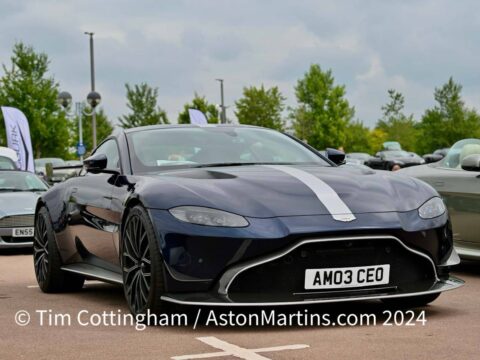
DB7 i6 Volante ‘Stratstone’ Edition
- 31/01/2013DB7 i6 Coupe ‘Stratstone’ Edition
- 29/09/2017In total, 19 examples were built which included 10 Volantes – all right hand drive and all destined for the UK market. Each car was individually numbered on the sill plates, together with the first owners name.
Particulars of the unique and fully loaded specification of the cars are listed below
- 1999MY
- Special order Bowland Black coachwork
- Light Grey interior, piped in charcoal (not 2 tone as seen in the regular DB7 i6)
- Charcoal leather upper environment, Stone Grey lower
- Seat headrests embossed with ‘Stratstone of Mayfair’
- Black carpets edged Light Grey
- Embroidered front over mats
- Polished mesh grille with chrome surround
- Smoke Alcantara headlining
- Numbered sill plaques
- Spark silver wheels
- Carbon fibre facias and gear surround (first time available on a DB7)
- CD player, Heated front screen
Customers took delivery of their cars at a special handover ceremony held at Blenheim Palace and were even transported to the venue by especially chartered helicopters.
DB7 V12 Vantage prototypes
- 31/01/2013Once these development cars have finished their life, they are usually scrapped totally. There are two main reasons for this. Firstly, to prevent any sub-standard or worn-out components being re-used on a car. And secondly, once scrapped, the car manufacturer can reclaim the VAT it has spent on the cost of the car. Many of the pictures below were taken in 2000 and 2001 of the ‘scrap yard’ at the back of the Newport Pagnell factory that is normally well off limits to the public. Most had been removed and scrapped by 2002.
In addition to the cars stored at the factory, which were subsequently destroyed, six engineering prototypes were sold off to special customers on the understanding that they would not be put on the road. Most but not all of these cars have been converted to race car spec although non has yet seen use in competition. One car that has been completed back to road spec is the silver DB7 engineering prototype, DP004 (below) which is part of a collection at Nobel House, the Dutch Aston Martin Heritage specialist.


DB7 V12 Vantage Coupe
- 31/01/2013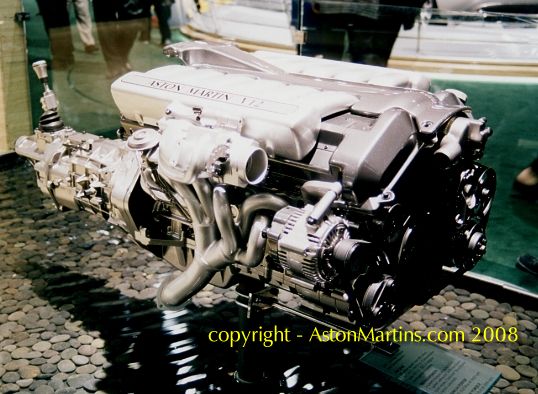 To the left is a display version engine from the DB7 Vantage, the first of a totally new generation, destined to became the future of Aston Martin during the first decade and a half of the 21st century. For the DB7 Vantage, the 5.9 litre, 48 valve, all-alloy, 60º V12 engine delivered 420 bhp and 400lbs ft of torque. Developed in close co-operation with the Ford Research and Vehicle Technology Group and Cosworth Technology, the V12 was designed to operate at a maximum speed of 7000rpm, features four valves per cylinder, twin overhead camshafts for each bank of cylinders and a sophisticated Visteon electronic management system. To cope with the massive increase in power, much of the chassis and suspension was extensively modified together with larger Brembo brakes.
Initially the car was available with either a six speed close ratio manual transmission (184 mph top speed, 0 to 60 mph in 5.0 seconds) or a five speed automatic (limited to 165 mph top speed, 0 to 60 mph in 5.1 seconds). From 2000, a highly acclaimed ‘Touchtronic’ system became available, developed in conjunction with ZF. The system has three transmission modes available to the Vantage driver. As well as a standard ‘automatic’ mode there is also a ‘sports’ mode where up changes were made at higher engine speeds. But drivers could also select ‘touchtronic’ mode which is a sequential manual mode. Gears can be changed by either moving the gear lever back and forth or by using ‘+’ and ‘-‘ buttons on the steering wheel.
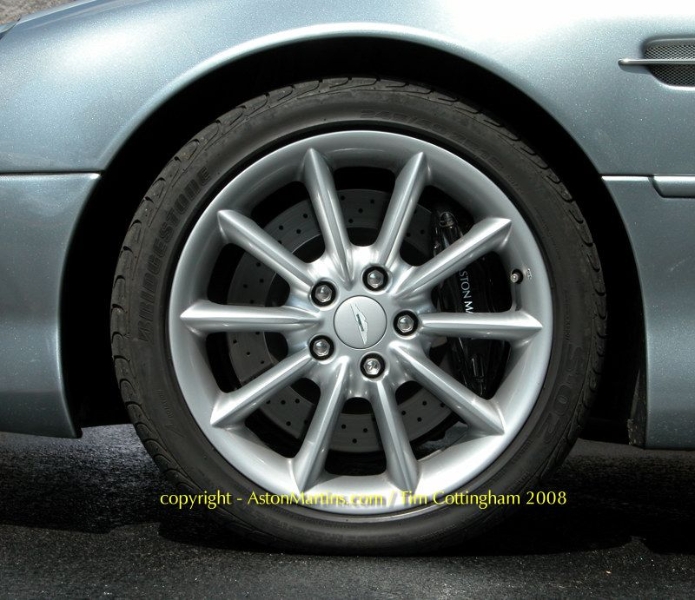
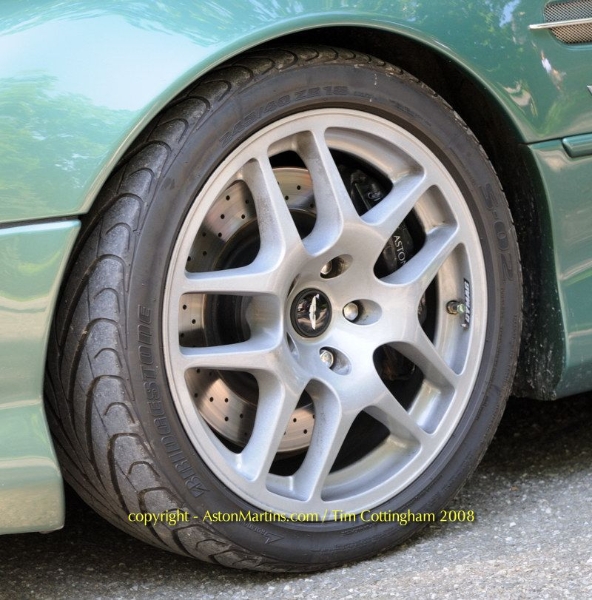
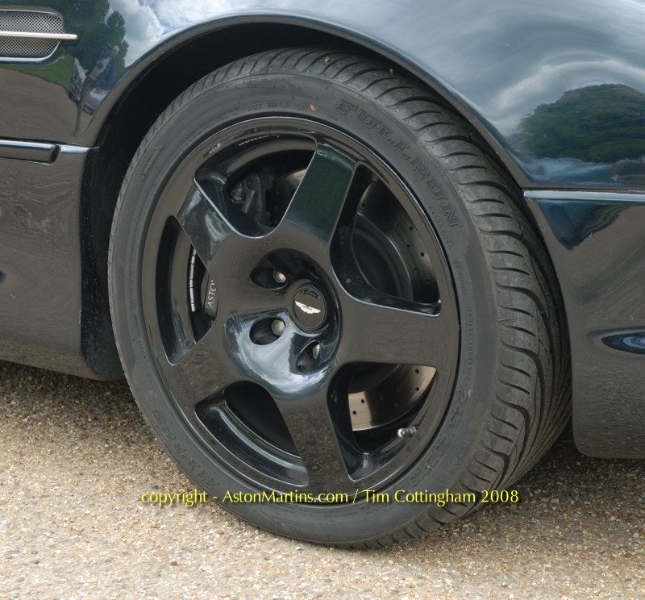
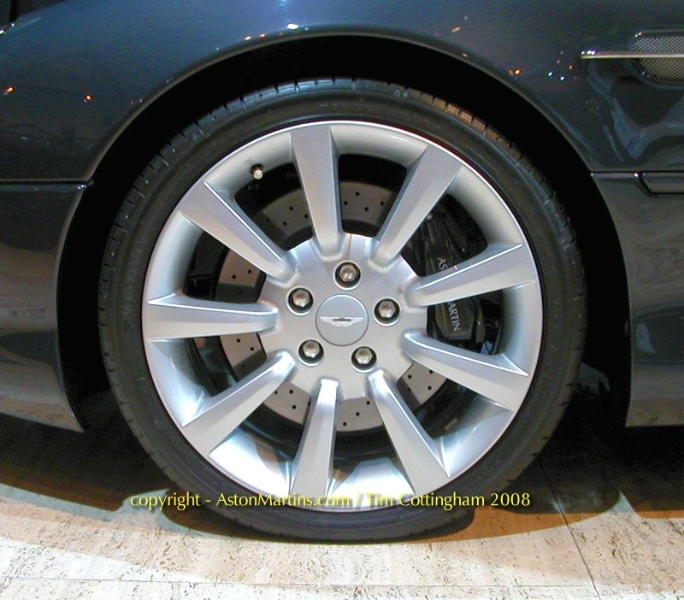
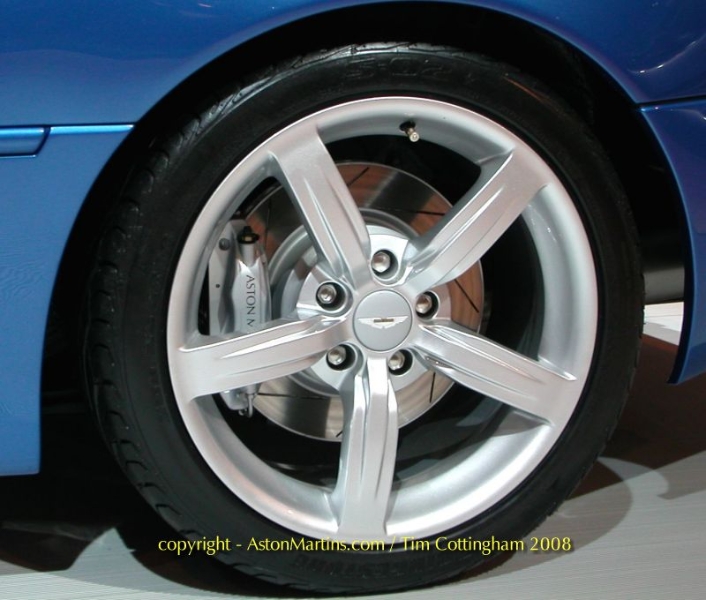
The images above illustrate the possible approved wheel options for the V12 DB7. The first image shows the standard 18 inch diameter, 10 spoke item. The second image shows the 18 inch 10 spoke ‘classic’ magnesium Dymag introduced in 2000. Dymag also make an 18 inch chunky 5 spoke design, known as ‘sport’ – perhaps the rarest DB7 wheel seen here finished body colour. The fourth image shows the 19 inch, 9 spoke design first offered in late 2001 for the 2002 model year. Lastly it is also possible to see V12 Vantages with the 18 inch 5 spoke wheel as fitted as standard to the V12 GT.
Below is the very last DB7 ever, which was completed by December 2003. It’s a right hand drive V12 Vantage coupe, chassis number 304458, finished in Aston Martin Racing Green. The car is being retained by the factory as it is occasionally displayed at the customer reception area at the Gaydon factory.
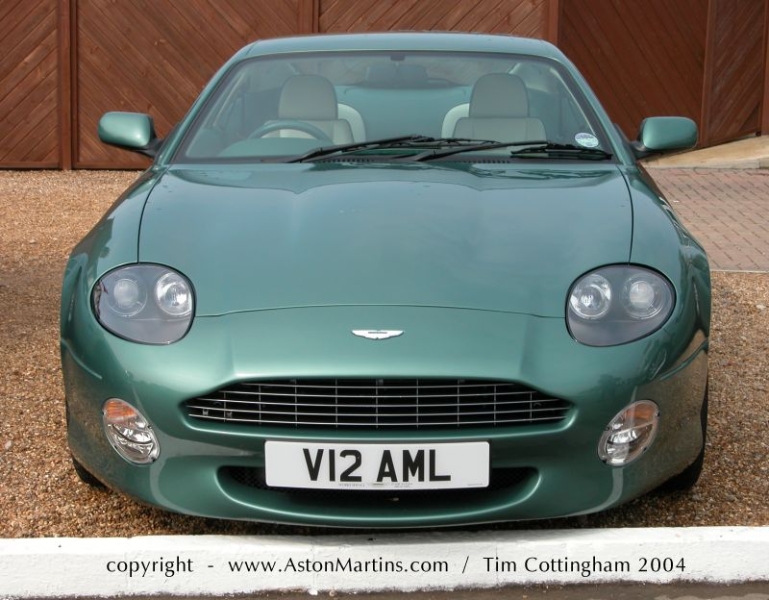
Total DB7 Vantage coupe production reached 2091 cars during four and a half years of building at the Bloxham site, which, together with the Volante and GT was an all time record for an Aston Martin model. The DB7 was replaced by the DB9 coupe in 2003.
DB7 V12 Vantage Volante
- 31/01/2013I guess the speed was restricted so that an over-enthusiastic driver doesn’t loose the roof when exploring the the extremes of the performance envelope. The Vantage Volante shares all the exterior features of it’s closed brother. The V12 engine (in stage 1 tune) needed more cooling air than the 6 cylinder and so the trademark Aston grille was enlarged. This meant the creation of new indicators and driving lights which were moved to a new position. These units are reminiscent of features on both the Project cars (DP212, DP214 and DP215) and the DBR1 race car.
Total production of the DB7 Vantage Volante reached 2059 examples, only a fraction behind the number of coupes built.
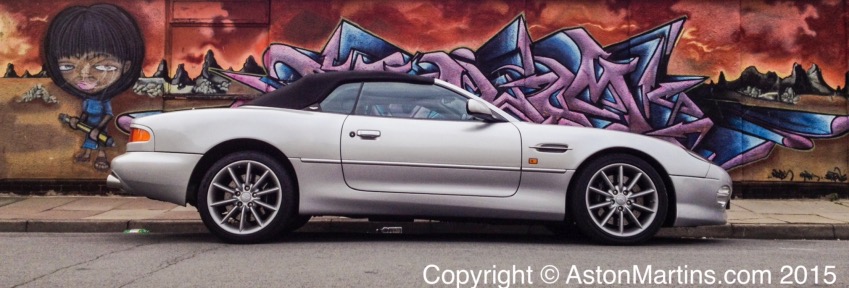
DB7 Vantage Volante in Dunhill Silver
DB7 V12 Vantage GTS II
- 13/12/2013DB7 V12 Vantage Volante LWB
- 09/05/2014DB7 V12 Vantage Driving Dynamics
- 31/01/2013Just to be clear, the rear lights are not officially known as Jaffa lights, but at least to my mind as reminiscent of the Jaffa grapefruit sold in the UK.
DB7 V12 Vantage Coupe ‘Stratstone Jubilee’ Edition
- 31/01/2013Particulars of the unique and ‘fully loaded’ Jubilee are listed below
- Coachwork finished in special order Jubilee Blue
- Magnolia Hide Interior with perforated seat centres and Jubilee embossed head restraints
- Contrasting Navy Blue dash top roll, door tops rear quarter panels and seat piping
- Dark blue Wilton carpets edged with Magnolia hide
- Blue over carpets edged in Magnolia with ‘Jubilee’ embroidered logo in silver
- Parchment Alcantara headlining
- Special order dark Italian Walnut
- White dials with silver jubilee graphics
- Special order 19 inch wheels
- Silver brake callipers with blue Aston Martin lettering
- Touchtronic Transmission
- Premium audio plus satellite navigation and Tracker 24 hour
- Heated front screen
- Fitted Umbrella (Black/Silver Handle)
- Large Bore Tail Pipes
- Satin Pedals
- Unique wide mesh chrome grille with ‘Jubilee’ badge and chrome door mirrors
- Clear side repeater lenses
- Numbered Jubilee sill plaques
- Handbook bound in Navy Blue hide and silver embossed plus a numbered limited edition gents chronograph watch
All this for a ‘just’ £120,950 – the standard Vantage coupe could be bought for £95,000 – admittedly without any extras what-so-ever.
All 24 cars were pre-sold and their lucky owners took delivery at a very special ceremony held at Thornbury Castle. The cars were especially hidden from the excited new owners during the daylight hours in a large marquee especially labelled ‘Tinnars Moat Craft Fair’ – Tinnars Moat is of course an anagram of Aston Martin. After a lavish meal, the sides of the dining marquee were dropped and the cars were revealed.
In addition to the UK/European cars, there were a further 26 cars made, all left hand drive, for the North American market to exactly the same cosmetic specifications.